
What Is Islam?
When many people in the USA or UK hear the word “Islam,” they often think about headlines, politics, terrorism, or controversy. But for nearly two billion Muslims around the world, Islam is not a political slogan or cultural identity alone — it is a complete way of life centered on purpose, morality, peace, and worshipping one God.
So what is Islam really?
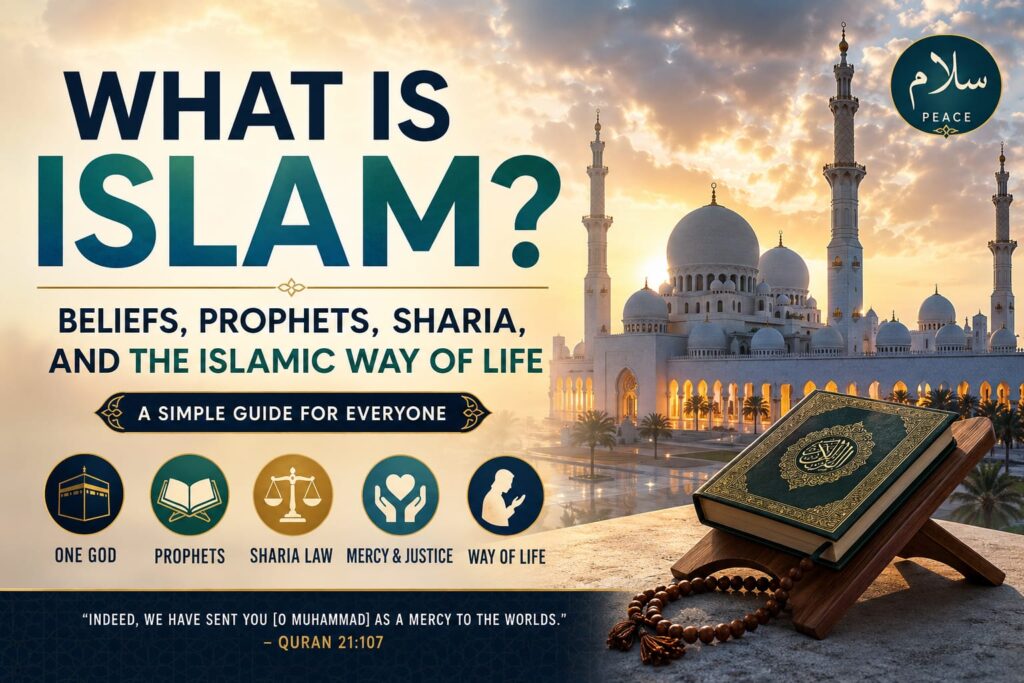
At its core, Islam is the belief that there is only one God, and that humanity was created to know Him, worship Him, and live according to His guidance. Muslims believe this message was taught by all prophets — including Adam, Noah, Abraham, Moses, Jesus, and finally Prophet Muhammad ﷺ. (Encyclopedia Britannica)
Islam is not presented as a “new religion.” Rather, Muslims believe it is the continuation and completion of the original message sent through all prophets throughout history.
For many non-Muslims, this is surprising. Few realize that Muslims deeply love Jesus, honor Moses, believe in the Virgin Mary, and see Prophet Muhammad ﷺ as the final messenger in the same prophetic tradition. That single point changes how many people begin to understand Islam.
The Meaning of Islam
The word Islam comes from the Arabic root related to peace and submission.
According to experts from Britannica, Islam literally refers to “surrender” to the will of God. A Muslim is someone who willingly submits to the Creator. (Encyclopedia Britannica)
This submission is not meant to be blind oppression. Muslims see it as liberation:
- Freedom from worshipping money
- Freedom from addiction
- Freedom from ego
- Freedom from society’s constant pressure
Islam teaches that real peace comes when a human being reconnects with the One who created them.
That is why many Muslims describe Islam not simply as a religion, but as a complete framework for life.
Islam Is a Way of Life
One of the biggest misunderstandings in Western society is thinking Islam is only about rituals.
In reality, Islam influences:
| Area of Life | Islamic Guidance |
|---|---|
| Family | Respect parents, kindness to spouse, raising children with morals |
| Business | Honesty, no fraud, fair trade |
| Charity | Helping the poor is mandatory |
| Mental Health | Prayer, gratitude, patience, remembrance of God |
| Community | Justice, mercy, caring for neighbors |
| Personal Conduct | Humility, modesty, discipline |
Islam teaches that even ordinary actions can become worship if done sincerely and ethically.
For example:
- Smiling at someone is considered charity
- Feeding the hungry is worship
- Caring for parents is highly honored
- Being truthful is a spiritual duty
This holistic approach is one reason many converts in America and Britain say Islam gave them structure, clarity, and purpose.
The Core Belief of Islam: One God
The central belief in Islam is called Tawhid — the absolute oneness of God.
Muslims believe:
- God has no partners
- God has no children
- God is eternal
- God is perfect
- God alone deserves worship
The Qur’an rejects the idea that humans, statues, money, celebrities, or spiritual figures should be worshipped.
Islam teaches a direct relationship with God:
- No priest required
- No confession booth
- No intermediaries
A Muslim can pray directly to God anywhere.
This simplicity attracts many people who feel spiritually disconnected in modern society.
Prophets in Islam
One of the most unique qualities of Islam is its respect for all prophets.
Muslims believe God sent prophets to every nation throughout history. (Encyclopedia Britannica)
Some major prophets in Islam include:
- Adam
- Noah
- Abraham
- Moses
- David
- Solomon
- Jonah
- John the Baptist
- Jesus
- Muhammad ﷺ
Muslims are required to respect all prophets.
Rejecting one prophet while accepting another is not considered true faith in Islam.
Jesus in Islam
For many Christians in the USA and UK, the biggest surprise is discovering how highly Jesus is honored in Islam.
Jesus (called Isa in Arabic) is one of the greatest prophets in Islam. (Encyclopedia Britannica)
Muslims believe:
- Jesus was born miraculously to the Virgin Mary
- Jesus performed miracles
- Jesus was the Messiah
- Jesus healed the sick by God’s permission
- Jesus will return before the Day of Judgment
However, Islam differs from Christianity on one major point:
Muslims do not believe Jesus is God or the literal son of God.
Instead, Muslims see Jesus as a mighty prophet who called people back to worshipping the One Creator.
This often surprises non-Muslims because the media rarely mentions Jesus in Islam.
Mary (Maryam) in Islam
Another remarkable fact:
Mary is one of the most respected women in Islam.
In fact:
- An entire chapter of the Qur’an is named after Mary
- The Qur’an speaks highly about her purity and devotion
- Muslim women around the world are named Maryam
For many non-Muslims, discovering the honor Islam gives to Mary changes their assumptions about the faith.
Moses in Islam
Moses (Musa) is actually mentioned more times in the Qur’an than any other prophet. (Yaqeen Institute for Islamic Research)
Muslims believe:
- Moses received revelation from God
- Moses confronted Pharaoh
- Moses led the Israelites
- Moses taught monotheism and divine law
The story of Moses in Islam shares many similarities with the Bible, while also emphasizing lessons about patience, justice, and reliance upon God.
Prophet Muhammad ﷺ: The Final Messenger
Muslims believe Prophet Muhammad ﷺ is the final prophet sent to humanity. (Encyclopedia Britannica)
To Muslims, he is not worshipped. He is respected as:
- The final messenger
- The best example of human character
- A mercy to humanity
Even many non-Muslim historians have praised his influence.
Michael Hart famously ranked Prophet Muhammad ﷺ as the most influential person in history because of his combined religious and social impact.
Muslims believe Prophet Muhammad ﷺ transformed:
- Tribal warfare into brotherhood
- Racism into equality
- Exploitation into justice
- Ignorance into literacy and morality
His teachings emphasized:
- Mercy
- Honesty
- Charity
- Family values
- Justice
- Forgiveness
This is why many Muslims describe Prophet Muhammad ﷺ as “the greatest of all time.”
The Five Pillars of Islam
Islam is built upon five foundational practices. (Encyclopedia Britannica)
| Pillar | Meaning |
|---|---|
| Shahadah | Declaring belief in one God and Muhammad ﷺ as His messenger |
| Salah | Five daily prayers |
| Zakat | Charity to the poor |
| Fasting | Ramadan fasting |
| Hajj | Pilgrimage to Mecca |
These practices create discipline, spirituality, and community.
What Is Islamic Sharia Law?
Perhaps no topic is more misunderstood in the West than Sharia law.
The term “Sharia” literally means “the path.” (Encyclopedia Britannica)
At its essence, Sharia is moral guidance derived from:
- The Qur’an
- The teachings of Prophet Muhammad ﷺ
It includes:
- Prayer
- Charity
- Marriage ethics
- Business honesty
- Justice
- Family rights
- Personal morality
Many Western media discussions reduce Sharia only to criminal punishments, but that is a very small portion of classical Islamic law.
For ordinary Muslims, Sharia mostly means:
- praying
- fasting
- being ethical
- avoiding harmful behavior
- living responsibly
Understanding this distinction is important when discussing Islam honestly.
Common Misconceptions About Islam
“Islam promotes violence”
Extremist groups receive media attention, but they do not represent mainstream Islam.
The Qur’an strongly condemns injustice and murder of innocent people.
The overwhelming majority of Muslims simply live ordinary lives:
- raising families
- working jobs
- worshipping God
- helping communities
“Muslim women are oppressed”
Cultural problems exist in many societies — including Muslim societies — but culture and religion are not always the same.
Islam gave women rights centuries ago, including:
- inheritance rights
- business ownership
- marriage consent
- education
Historically, these rights appeared long before many Western legal systems offered them.
“Islam spread by the sword”
History is more complex than simplistic internet slogans.
Islam spread through:
- trade
- scholarship
- migration
- spirituality
- missionary work
- ethical influence
Large Muslim populations in places like Indonesia emerged mainly through trade and peaceful interaction.
Why Many People Are Exploring Islam Today
Despite constant criticism in media, Islam continues to grow globally.
Many converts in the USA and UK mention similar reasons for accepting Islam:
1. Clarity About God
Islam presents a simple, direct understanding of the Creator.
2. Purpose
Islam answers major life questions:
- Why are we here?
- What happens after death?
- What is morality?
3. Discipline
Prayer, fasting, and moral accountability create structure.
4. Brotherhood & Community
Many converts say they found belonging and equality in Islam.
5. Preservation
Muslims believe the Qur’an has remained preserved since revelation.
Is Islam the True Religion?
Muslims believe Islam is the final and complete revelation from God.
However, Islam also teaches respect, dialogue, and freedom of belief.
The Qur’an repeatedly invites people to:
- think
- reflect
- question
- seek truth sincerely
Islamic belief is not supposed to rest only on blind inheritance, but on conviction built through reflection and evidence.
For Muslims, Islam is true because they believe:
- the Qur’an is divine revelation
- Prophet Muhammad ﷺ was truthful
- Islam provides consistent answers about life and morality
- the message aligns with human nature
Qualities of Islam That Stand Out
Some qualities of Islam that many non-Muslims appreciate include:
- Simplicity
- Discipline
- Charity
- Family values
- Spiritual connection
- Personal responsibility
- Equality before God
- Moral structure
- Community support
Islam teaches that race, nationality, and wealth do not make someone superior.
According to Islamic teaching:
“The best among you are those with the best character.”
Final Thoughts: What Is Islam Really About?
Islam is ultimately about knowing your Creator and living with purpose.
It teaches:
- one God
- moral responsibility
- compassion
- accountability
- justice
- worship
- hope
For Muslims, Islam is not merely a Sunday religion or cultural identity.
It is a complete worldview shaping daily life, ethics, spirituality, and human relationships.
Whether someone agrees with Islam or not, understanding it fairly matters — especially in a world full of misinformation and stereotypes.
The more honestly people learn about Islam, the more they often realize:
the real Islam is very different from the version presented in headlines.
Suggested Visuals for This Blog
📸 Images
- Muslims praying in a mosque
- Ramadan family dinner
- Qur’an with soft lighting
- Mecca aerial view
- Islamic geometric art
- Interfaith discussion image
📊 Infographic Ideas
- “Prophets in Islam Timeline”
- “Five Pillars of Islam”
- “Jesus in Christianity vs Jesus in Islam”
- “What Sharia Actually Means”
Recommended External Sources
Internal Linking Suggestions for Your Website
You can internally link this article to:
- “Who Is Prophet Muhammad ﷺ?”
- “Jesus in Islam Explained”
- “What Is the Qur’an?”
- “What Happens After Death in Islam?”
- “Women’s Rights in Islam”
- “Top Misconceptions About Islam”
Call To Action
What surprised you most about Islam?
Share your thoughts respectfully in the comments below. If you found this article useful, share it with someone curious about Islam.
For more authentic Islamic content, subscribe to Hafiz Khalid Saifullah and explore more articles at:
